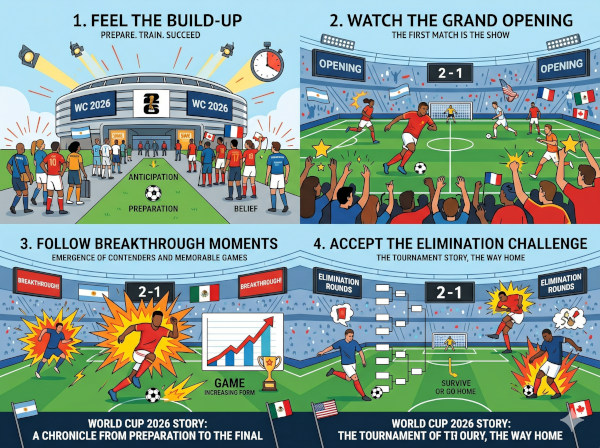
This complete overview gives fans more than a fixture list. World Cup 2026 is built on scale, movement and story: a larger field of national teams, three host countries, a long summer calendar and a tournament structure that creates more pressure points than any previous edition.
The aim is straightforward: a team-by-team compass that turns qualification lists into football narratives. Supporters can use it to understand the competition before it begins, follow the right storylines during the event and move easily into deeper guides on teams, format, stadiums, host cities and highlights.
Why the team list is a map of future stories
The team conversation should begin with the obvious names but never end there. Argentina, Brazil, France, Spain, England, Portugal, Germany, the Netherlands, Belgium and Uruguay all carry different forms of expectation, history and tactical identity. Some arrive with the burden of past victories, some with a generation approaching its prime, and some with the uncomfortable feeling that the football world expects a statement.
A smarter way to read contenders is to look beyond reputation. Tournament football rewards goalkeeper form, set-piece detail, bench impact, emotional control and the ability to win ugly games. A side that looks ordinary in possession can still become dangerous if it defends the box, breaks with speed and has two or three players who accept pressure in decisive moments.
Underdogs deserve the same seriousness. Expanded qualification means more football cultures on the stage, and that creates unfamiliar tactical problems for established powers. A disciplined outsider can change a group by taking points from a favourite, protecting a narrow lead or forcing a bigger nation into a physically draining match before the knockout rounds.
For supporters, the useful next step is to connect the theme to match behaviour. A rule, venue or storyline becomes meaningful when it explains why a coach rotates, why a crowd grows nervous, why a favourite changes tempo or why a smaller nation suddenly believes the bracket has opened.
Qualified teams and how to keep the list current
The team conversation should begin with the obvious names but never end there. Argentina, Brazil, France, Spain, England, Portugal, Germany, the Netherlands, Belgium and Uruguay all carry different forms of expectation, history and tactical identity. Some arrive with the burden of past victories, some with a generation approaching its prime, and some with the uncomfortable feeling that the football world expects a statement.
A smarter way to read contenders is to look beyond reputation. Tournament football rewards goalkeeper form, set-piece detail, bench impact, emotional control and the ability to win ugly games. A side that looks ordinary in possession can still become dangerous if it defends the box, breaks with speed and has two or three players who accept pressure in decisive moments.
Underdogs deserve the same seriousness. Expanded qualification means more football cultures on the stage, and that creates unfamiliar tactical problems for established powers. A disciplined outsider can change a group by taking points from a favourite, protecting a narrow lead or forcing a bigger nation into a physically draining match before the knockout rounds.
This is also where the tournament becomes easier to follow from home. A fan who understands context can watch warm-ups, substitutions, set pieces and crowd reactions with more attention, because each detail may reveal how a team is handling the occasion rather than simply how the scoreboard looks.
Favorites carrying the heaviest expectations
The team conversation should begin with the obvious names but never end there. Argentina, Brazil, France, Spain, England, Portugal, Germany, the Netherlands, Belgium and Uruguay all carry different forms of expectation, history and tactical identity. Some arrive with the burden of past victories, some with a generation approaching its prime, and some with the uncomfortable feeling that the football world expects a statement.
A smarter way to read contenders is to look beyond reputation. Tournament football rewards goalkeeper form, set-piece detail, bench impact, emotional control and the ability to win ugly games. A side that looks ordinary in possession can still become dangerous if it defends the box, breaks with speed and has two or three players who accept pressure in decisive moments.
Underdogs deserve the same seriousness. Expanded qualification means more football cultures on the stage, and that creates unfamiliar tactical problems for established powers. A disciplined outsider can change a group by taking points from a favourite, protecting a narrow lead or forcing a bigger nation into a physically draining match before the knockout rounds.
The strongest World Cup coverage avoids treating each fact as isolated trivia. The same detail can influence travel, rest, team selection, ticket demand and the emotional weight of a match. That layered reading is what turns a schedule entry into a story.
Key takeaways:
- Use the official tournament structure as the factual base.
- Connect every match or city detail to a clear fan benefit.
- Avoid overconfident predictions before team news and form are known.
- Guide readers toward related pages instead of repeating the same overview.
Second-tier contenders with a route to a deep run
The central structural fact is simple: The 2026 FIFA World Cup is the first edition planned for 48 teams, staged across Canada, Mexico and the United States. The tournament window runs from 11 June to 19 July 2026, and the competition structure creates 104 matches instead of the 64-game rhythm familiar from recent editions. The group stage is built around twelve groups of four, with the top two in every group and the eight strongest third-placed teams moving into a new round of 32. That change alters the rhythm of the tournament for fans, coaches and players. There is more room for new national teams to appear, but there is also more complexity in reading tables and projecting routes through the bracket.
For supporters, the key is to treat the group stage as a sequence of pressure points rather than a single table. The first match sets the mood, the second match tests whether that mood was real, and the third match usually becomes a calculation of points, goal difference and risk tolerance. A team can look safe for most of a night and still be dragged into danger by one late goal in another city.
The move into the knockout phase changes the language of the tournament. Draws disappear as a comfort zone, rotation becomes harder, and a coach's decision in the 60th minute can define a whole campaign. That is why a format guide should not only describe the rules; it should explain how those rules change behaviour on the pitch and in the stands.
A practical reader takeaway is to keep notes as the tournament develops. Early impressions often change quickly, but the first clues about squad depth, pressing intensity, defensive concentration and set-piece quality can become important once the knockout rounds begin.
Underdogs, debutants and emotional tournament arcs
Every World Cup needs its story engine. Rivalries bring memory, rising stars bring discovery, veterans bring urgency, and underdogs bring the possibility that neutral fans secretly crave. The 2026 edition offers a larger stage, which means more parallel stories can develop before the tournament narrows into the knockout rounds.
Classic rivalries matter because they arrive with emotional shorthand. Supporters do not need a long explanation to understand why certain shirts, anthems and histories create tension. New rivalries are different; they are born from style clashes, controversial moments, bracket meetings and players who share club history but stand on opposite sides for their countries.
A story page should be updated like a living notebook. Before the tournament, it can preview likely narratives. During the tournament, it should promote the stories that prove themselves on the pitch. After the tournament, it can preserve the arcs that defined the event: the youngster who became famous, the veteran's final run, or the outsider who forced the world to pay attention.
This theme also helps build clean internal navigation. When readers want more detail, they should be able to move naturally into guides on teams, format, stadiums, host cities, schedule and highlights without feeling that the same paragraph has been recycled.
Regional storylines across the confederations
Every World Cup needs its story engine. Rivalries bring memory, rising stars bring discovery, veterans bring urgency, and underdogs bring the possibility that neutral fans secretly crave. The 2026 edition offers a larger stage, which means more parallel stories can develop before the tournament narrows into the knockout rounds.
Classic rivalries matter because they arrive with emotional shorthand. Supporters do not need a long explanation to understand why certain shirts, anthems and histories create tension. New rivalries are different; they are born from style clashes, controversial moments, bracket meetings and players who share club history but stand on opposite sides for their countries.
A story page should be updated like a living notebook. Before the tournament, it can preview likely narratives. During the tournament, it should promote the stories that prove themselves on the pitch. After the tournament, it can preserve the arcs that defined the event: the youngster who became famous, the veteran's final run, or the outsider who forced the world to pay attention.
The football value is in the tension between expectation and evidence. Reputation tells fans where to look, but the matches reveal whether a team can handle heat, travel, crowd noise, tactical adjustments and the emotional shock of a goal against the run of play.
Key takeaways:
- Use the official tournament structure as the factual base.
- Connect every match or city detail to a clear fan benefit.
- Avoid overconfident predictions before team news and form are known.
- Guide readers toward related pages instead of repeating the same overview.
Squad reading: coach, leader, goalkeeper and bench
The team conversation should begin with the obvious names but never end there. Argentina, Brazil, France, Spain, England, Portugal, Germany, the Netherlands, Belgium and Uruguay all carry different forms of expectation, history and tactical identity. Some arrive with the burden of past victories, some with a generation approaching its prime, and some with the uncomfortable feeling that the football world expects a statement.
A smarter way to read contenders is to look beyond reputation. Tournament football rewards goalkeeper form, set-piece detail, bench impact, emotional control and the ability to win ugly games. A side that looks ordinary in possession can still become dangerous if it defends the box, breaks with speed and has two or three players who accept pressure in decisive moments.
Underdogs deserve the same seriousness. Expanded qualification means more football cultures on the stage, and that creates unfamiliar tactical problems for established powers. A disciplined outsider can change a group by taking points from a favourite, protecting a narrow lead or forcing a bigger nation into a physically draining match before the knockout rounds.
For neutral fans, this is part of the joy of the World Cup. They can arrive with no fixed allegiance and still find a reason to care: a city, a young player, a brave underdog, a tactical duel or a late moment that changes the table.
Teams FAQ and update notes
The best FAQ block does not repeat the whole article. It answers the next obvious question and then points the reader to the deeper page that solves it properly. For World Cup 2026 content, that means short answers on format, teams, schedule, host cities and stadiums, followed by clear internal links rather than a wall of duplicated copy.
A strong question set should cover the basics first: when the tournament starts, how many teams are involved, how the new round of 32 works, which countries are hosting, and where fans should check official updates. After that, it can move into more editorial questions, such as which teams have the most pressure, which cities may deliver the strongest atmosphere, and which storylines can dominate the opening week.
The final answer on the page should feel like a handoff. A reader who came for one quick explanation should leave with two or three natural next steps: the format guide for structure, the teams page for contenders and underdogs, and the schedule page for key dates. That is how a FAQ becomes part of the site architecture rather than an afterthought.
As the tournament approaches, this section should remain easy to update. Team news, venue information and official scheduling details can shift, and the best page will keep the evergreen explanation while refreshing the practical details when reliable updates appear.
Conclusion
The strongest way to follow World Cup 2026 is to keep both views open at the same time: the wide angle of the tournament and the close-up detail of each match. The wide angle explains why the format, cities and schedule matter. The close-up detail explains why one tactical change, one young player or one late goal can rewrite the story.
GoalHarbor should use this page as part of a connected World Cup hub. Readers can start here, then continue into the format guide, teams guide, schedule guide, host-city guide, stadium guide and highlights archive. Together, those pages create a complete editorial pathway from anticipation to tournament memory.