This educational guide explains football betting without hype. The goal is to clarify terminology, markets, tools and decision habits while keeping risk visible at every step.
The aim is straightforward: a responsible entry guide to markets, odds, site choice and safer play. Betting should remain optional entertainment for adults in legal jurisdictions, never a financial plan, a response to stress or a way to recover previous losses.
Why football online betting became a separate market
Odds are a price, not a prediction. They express how the bookmaker has priced uncertainty after accounting for probability, demand, risk and margin. A low price does not mean an outcome is guaranteed; it means the operator is offering a smaller return because that outcome is considered more likely or more heavily backed.
Implied probability helps readers translate odds into a clearer view. Decimal odds of 2.00 imply roughly a 50 percent break-even point before margin, while shorter odds require a higher win rate to be worthwhile over time. This does not create certainty, but it gives the user a better way to compare a feeling with the price being offered.
Value is often misunderstood. A value bet is not a bet that will definitely win; it is a bet where the user's assessed probability is higher than the probability implied by the odds. That assessment can still be wrong. For that reason, odds education must sit beside bankroll rules, comparison habits and the reminder that variance can defeat even a well-reasoned opinion in the short term.
The safest habit is to slow the decision down. Before a bet is placed, the user should be able to name the market, explain the price, set the stake, accept the possible loss and know exactly when the session will stop. If any of those steps are unclear, passing is the better decision.
What football online betting means
Odds are a price, not a prediction. They express how the bookmaker has priced uncertainty after accounting for probability, demand, risk and margin. A low price does not mean an outcome is guaranteed; it means the operator is offering a smaller return because that outcome is considered more likely or more heavily backed.
Implied probability helps readers translate odds into a clearer view. Decimal odds of 2.00 imply roughly a 50 percent break-even point before margin, while shorter odds require a higher win rate to be worthwhile over time. This does not create certainty, but it gives the user a better way to compare a feeling with the price being offered.
Value is often misunderstood. A value bet is not a bet that will definitely win; it is a bet where the user's assessed probability is higher than the probability implied by the odds. That assessment can still be wrong. For that reason, odds education must sit beside bankroll rules, comparison habits and the reminder that variance can defeat even a well-reasoned opinion in the short term.
A responsible betting page should never make action feel urgent. Football will always produce another fixture, another market and another price. The user does not need to chase a line simply because it is on screen or because a notification has appeared.
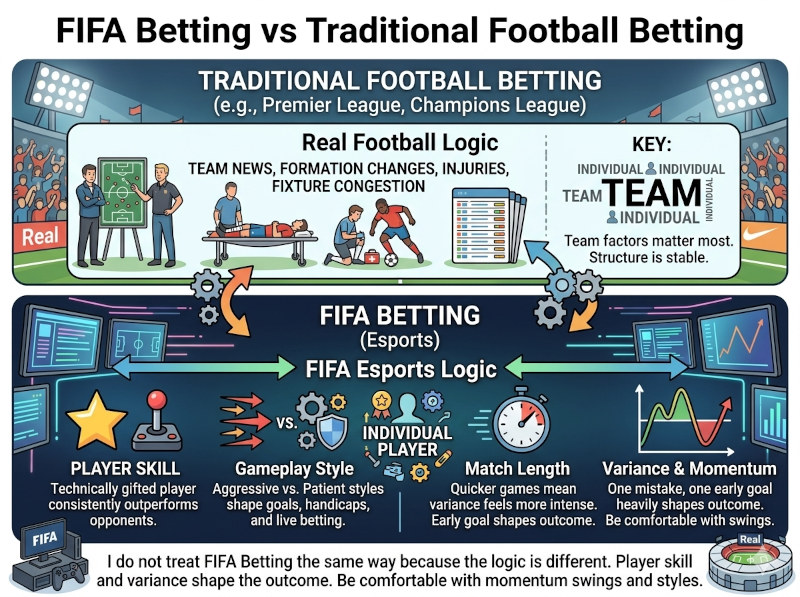
How it differs from traditional football betting
At this stage, the reader needs practical clarity without hype. The explanation should be useful, but it should also keep the risk visible. Football betting is only for adults who are legally allowed to bet in their own location. Nothing on this page should be read as financial advice or a promise of profit. Betting involves risk, outcomes remain uncertain, and the safest approach is to use licensed operators, fixed limits and responsible gambling tools.
A strong betting article separates football knowledge from betting discipline. Knowing teams, tactics and match context can improve the quality of a user's reasoning, but it does not protect against variance or poor money management. That is why every educational point should be paired with a process: compare prices, set a budget, check the rules and decide in advance when the session ends.
This page should connect naturally with the wider betting cluster: football betting markets guide, live football betting guide, mobile football betting guide, football betting odds guide, responsible football betting guide. Internal links are especially important here because users often arrive with one narrow question and need a safer path to related topics such as odds, markets, licensing and responsible play.
The practical value comes from process. Compare odds, read rules, check local legality, understand settlement, protect account security and keep the bankroll separate from everyday money. Those habits matter more than a single opinion about one match.
Key takeaways:
- Use licensed operators only where betting is legal for the user.
- Understand the market and the odds before confirming any stake.
- Set budget, time and loss limits before the session starts.
- Skip the bet whenever emotion is stronger than reasoning.
Pre-match, live and mobile betting explained
Live betting compresses time. Odds move while the match is changing, and the user feels that every attack, card or substitution demands an immediate response. That speed is the appeal, but it is also the danger. A good live betting guide should slow the reader down before explaining any tactical signal.
Useful live signals include territory, shot quality, pressure after losing the ball, set-piece volume, player fatigue, tactical substitutions and whether one team is protecting a lead or actively chasing another goal. None of these signals guarantees the next event. They only help the user understand whether the live price still reflects what is happening on the pitch.
The most underrated live betting skill is passing. If the stream is delayed, the price has already moved, the user is annoyed by a previous loss, or the market is unclear, the right decision may be no bet. That advice may sound conservative, but it is exactly what separates an educational page from a page that simply pushes action.
Emotion is the biggest hidden variable. A fan may know the sport well and still make poor choices after a late goal, a bad beat or a losing run. The copy should normalise breaks, time-outs and the decision to log off.
Core markets: winner, totals, BTTS, handicap and correct score
Both teams to score, or BTTS, is not a prediction that the game will be wild. It only needs each side to score once. That makes it useful when both teams have attacking routes but neither defence looks completely secure.
Good BTTS research looks at full-back aggression, set-piece quality, transition defence and whether both teams have a reason to keep attacking. A favourite can win comfortably and still concede from one counter or dead ball.
The mistake is to use BTTS automatically in matches with famous forwards. A team can have star attackers and still be controlled by game state, fatigue or a defensive opponent.
A strong internal link path should guide the reader toward markets, odds, live betting, mobile safety and responsible gambling tools. That structure supports SEO, but it also helps users learn in a safer order instead of jumping straight into high-risk choices.
How to evaluate a betting site
Choosing a betting site should start with safety, not bonuses. A large welcome offer can look attractive, but it matters far less than licensing, withdrawal reliability, market clarity, account security and access to responsible gambling tools. If those basics are weak, the bonus is a distraction rather than a benefit.
Market depth is another quality signal. A stronger sportsbook should offer core football markets, sensible live coverage, clear odds movement, straightforward rules and enough information for the user to understand what is being settled. Thin or confusing markets make comparison harder and increase the chance of mistakes.
Payments and support should be tested with caution. Users should read deposit and withdrawal limits, processing times, identity requirements and fees before committing money. Customer support should be easy to find, and terms should be written clearly enough that a new user can understand them without hunting through pages of legal language.
The user should remember that larger odds usually reflect lower probability. A bigger potential payout does not make a selection smarter. It only means more uncertainty is being priced into the offer, and that uncertainty must be respected.
Key takeaways:
- Use licensed operators only where betting is legal for the user.
- Understand the market and the odds before confirming any stake.
- Set budget, time and loss limits before the session starts.
- Skip the bet whenever emotion is stronger than reasoning.
Discipline and risk management
Odds are a price, not a prediction. They express how the bookmaker has priced uncertainty after accounting for probability, demand, risk and margin. A low price does not mean an outcome is guaranteed; it means the operator is offering a smaller return because that outcome is considered more likely or more heavily backed.
Implied probability helps readers translate odds into a clearer view. Decimal odds of 2.00 imply roughly a 50 percent break-even point before margin, while shorter odds require a higher win rate to be worthwhile over time. This does not create certainty, but it gives the user a better way to compare a feeling with the price being offered.
Value is often misunderstood. A value bet is not a bet that will definitely win; it is a bet where the user's assessed probability is higher than the probability implied by the odds. That assessment can still be wrong. For that reason, odds education must sit beside bankroll rules, comparison habits and the reminder that variance can defeat even a well-reasoned opinion in the short term.
Legal and account checks are part of the experience, not an obstacle to it. Age verification, identity review, payment checks and location restrictions exist to create a regulated environment where consumer protection can function.
FAQ and specialist guides
A useful FAQ should answer practical questions without encouraging impulsive decisions. Readers may want to know what a market means, why odds change, whether a site is legal where they live, how to set limits, and when to stop. Each answer should be short, direct and responsible, with a link to the deeper guide when the topic needs more explanation.
The safest answers repeat the same principles without sounding robotic: check local law, use licensed operators, understand the market before placing a bet, avoid chasing losses, and treat betting as paid entertainment rather than a plan for income. These points are not decorative disclaimers; they are the foundation of a trustworthy betting cluster.
The FAQ should also connect readers to specialist pages such as football betting markets guide, live football betting guide, mobile football betting guide, football betting odds guide, responsible football betting guide. That internal structure helps the site rank for long-tail questions while keeping the user journey educational instead of aggressive.
The final practical filter is simple: would the same bet still make sense tomorrow, after the emotion has cooled? If the answer is no, the decision is probably being driven by mood rather than analysis.
Conclusion
The most important betting habit is not finding one perfect pick. It is building a process that makes fewer rushed decisions, respects uncertainty and protects the user's money, time and attention. Football knowledge can make the experience more informed, but discipline is what keeps it safer.
Readers should use this page as education, not instruction to bet. Check local law, choose licensed operators only where betting is legal, set limits before depositing, and step away if betting creates stress or pressure. The responsible betting page should remain one of the most visible links in the whole cluster.
Responsible betting note
Football betting is only for adults who are legally allowed to bet in their own location. Nothing on this page should be read as financial advice or a promise of profit. Betting involves risk, outcomes remain uncertain, and the safest approach is to use licensed operators, fixed limits and responsible gambling tools.
Final practical notes for readers
The safest betting content gives readers permission not to bet. That sentence matters because many users arrive on a betting page expecting encouragement. A trustworthy guide should make clear that skipping a market is not failure; it is often the most disciplined choice available.
Bankroll language should stay simple. The user should separate betting money from everyday money, decide the maximum affordable loss in advance, avoid borrowing to bet and never increase stakes because of frustration. Those rules are basic, but they protect users better than any clever prediction.
Market education should always include settlement awareness. Before placing a bet, the user should know exactly what result is needed, whether extra time counts, how voids work, what happens if a player does not start and whether the sportsbook's rules differ from another operator's rules.
Price comparison is useful, but it should not become an obsession. Searching for a better line can improve discipline when done calmly, yet constant line-watching can also create pressure. The user should compare prices as part of a planned process, not as a trigger for impulsive action.
Live betting deserves special caution because it creates the illusion of control. Watching the match can provide useful information, but fast-changing odds, broadcast delay and emotional momentum can still lead to poor decisions. A pause before confirming the bet is one of the simplest safety tools.