This complete overview gives fans more than a fixture list. World Cup 2026 is built on scale, movement and story: a larger field of national teams, three host countries, a long summer calendar and a tournament structure that creates more pressure points than any previous edition.
The aim is straightforward: a travel and atmosphere guide that treats each city as part of the football experience. Supporters can use it to understand the competition before it begins, follow the right storylines during the event and move easily into deeper guides on teams, format, stadiums, host cities and highlights.
Why host cities shape World Cup memory
World Cup 2026 is not happening in one football city; it is spread across Atlanta, Boston, Dallas, Guadalajara, Houston, Kansas City, Los Angeles, Mexico City, Miami, Monterrey, New York/New Jersey, Philadelphia, the San Francisco Bay Area, Seattle, Toronto and Vancouver. That distribution gives the tournament a different emotional map. Some matchdays will feel shaped by dense urban streets, others by long travel corridors, stadium districts and fan gatherings built around a city that may be hosting its biggest football week in decades.
For a travelling supporter, the host city is part of the match. Arrival time, local transport, climate, stadium access, fan zones, food options and the walk back after full time all influence the memory of the game. A 2-1 win can feel different in a city where the crowd pours into downtown squares than it does in a venue built around parking lots and shuttle plans.
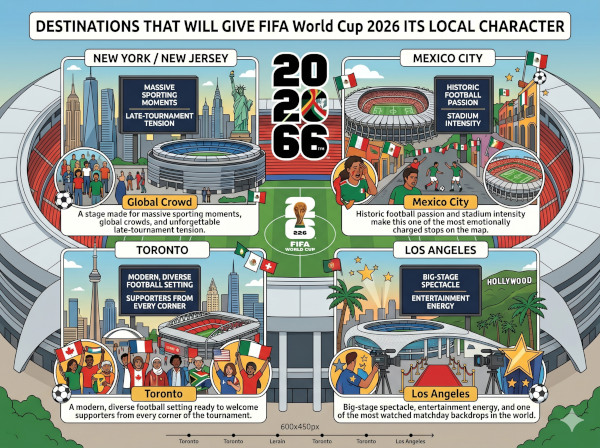
For readers watching from home, city context still matters. Broadcasts will carry images of skylines, street parties, national colours and stadium exteriors. Those visuals become part of the tournament archive. A good host-city page should help readers understand why a fixture in Mexico City, Toronto, Los Angeles or New York/New Jersey has its own personality before the teams even line up.
For supporters, the useful next step is to connect the theme to match behaviour. A rule, venue or storyline becomes meaningful when it explains why a coach rotates, why a crowd grows nervous, why a favourite changes tempo or why a smaller nation suddenly believes the bracket has opened.
Three host countries as one football stage
The central structural fact is simple: The 2026 FIFA World Cup is the first edition planned for 48 teams, staged across Canada, Mexico and the United States. The tournament window runs from 11 June to 19 July 2026, and the competition structure creates 104 matches instead of the 64-game rhythm familiar from recent editions. The group stage is built around twelve groups of four, with the top two in every group and the eight strongest third-placed teams moving into a new round of 32. That change alters the rhythm of the tournament for fans, coaches and players. There is more room for new national teams to appear, but there is also more complexity in reading tables and projecting routes through the bracket.
For supporters, the key is to treat the group stage as a sequence of pressure points rather than a single table. The first match sets the mood, the second match tests whether that mood was real, and the third match usually becomes a calculation of points, goal difference and risk tolerance. A team can look safe for most of a night and still be dragged into danger by one late goal in another city.
The move into the knockout phase changes the language of the tournament. Draws disappear as a comfort zone, rotation becomes harder, and a coach's decision in the 60th minute can define a whole campaign. That is why a format guide should not only describe the rules; it should explain how those rules change behaviour on the pitch and in the stands.
This is also where the tournament becomes easier to follow from home. A fan who understands context can watch warm-ups, substitutions, set pieces and crowd reactions with more attention, because each detail may reveal how a team is handling the occasion rather than simply how the scoreboard looks.
How to profile every host city
World Cup 2026 is not happening in one football city; it is spread across Atlanta, Boston, Dallas, Guadalajara, Houston, Kansas City, Los Angeles, Mexico City, Miami, Monterrey, New York/New Jersey, Philadelphia, the San Francisco Bay Area, Seattle, Toronto and Vancouver. That distribution gives the tournament a different emotional map. Some matchdays will feel shaped by dense urban streets, others by long travel corridors, stadium districts and fan gatherings built around a city that may be hosting its biggest football week in decades.
For a travelling supporter, the host city is part of the match. Arrival time, local transport, climate, stadium access, fan zones, food options and the walk back after full time all influence the memory of the game. A 2-1 win can feel different in a city where the crowd pours into downtown squares than it does in a venue built around parking lots and shuttle plans.
For readers watching from home, city context still matters. Broadcasts will carry images of skylines, street parties, national colours and stadium exteriors. Those visuals become part of the tournament archive. A good host-city page should help readers understand why a fixture in Mexico City, Toronto, Los Angeles or New York/New Jersey has its own personality before the teams even line up.
The strongest World Cup coverage avoids treating each fact as isolated trivia. The same detail can influence travel, rest, team selection, ticket demand and the emotional weight of a match. That layered reading is what turns a schedule entry into a story.
Key takeaways:
- Use the official tournament structure as the factual base.
- Connect every match or city detail to a clear fan benefit.
- Avoid overconfident predictions before team news and form are known.
- Guide readers toward related pages instead of repeating the same overview.
Featured cities: New York/New Jersey, Mexico City, Toronto and Los Angeles
World Cup 2026 is not happening in one football city; it is spread across Atlanta, Boston, Dallas, Guadalajara, Houston, Kansas City, Los Angeles, Mexico City, Miami, Monterrey, New York/New Jersey, Philadelphia, the San Francisco Bay Area, Seattle, Toronto and Vancouver. That distribution gives the tournament a different emotional map. Some matchdays will feel shaped by dense urban streets, others by long travel corridors, stadium districts and fan gatherings built around a city that may be hosting its biggest football week in decades.
For a travelling supporter, the host city is part of the match. Arrival time, local transport, climate, stadium access, fan zones, food options and the walk back after full time all influence the memory of the game. A 2-1 win can feel different in a city where the crowd pours into downtown squares than it does in a venue built around parking lots and shuttle plans.
For readers watching from home, city context still matters. Broadcasts will carry images of skylines, street parties, national colours and stadium exteriors. Those visuals become part of the tournament archive. A good host-city page should help readers understand why a fixture in Mexico City, Toronto, Los Angeles or New York/New Jersey has its own personality before the teams even line up.
A practical reader takeaway is to keep notes as the tournament develops. Early impressions often change quickly, but the first clues about squad depth, pressing intensity, defensive concentration and set-piece quality can become important once the knockout rounds begin.
How to choose a city for a match trip
World Cup 2026 is not happening in one football city; it is spread across Atlanta, Boston, Dallas, Guadalajara, Houston, Kansas City, Los Angeles, Mexico City, Miami, Monterrey, New York/New Jersey, Philadelphia, the San Francisco Bay Area, Seattle, Toronto and Vancouver. That distribution gives the tournament a different emotional map. Some matchdays will feel shaped by dense urban streets, others by long travel corridors, stadium districts and fan gatherings built around a city that may be hosting its biggest football week in decades.
For a travelling supporter, the host city is part of the match. Arrival time, local transport, climate, stadium access, fan zones, food options and the walk back after full time all influence the memory of the game. A 2-1 win can feel different in a city where the crowd pours into downtown squares than it does in a venue built around parking lots and shuttle plans.
For readers watching from home, city context still matters. Broadcasts will carry images of skylines, street parties, national colours and stadium exteriors. Those visuals become part of the tournament archive. A good host-city page should help readers understand why a fixture in Mexico City, Toronto, Los Angeles or New York/New Jersey has its own personality before the teams even line up.
This theme also helps build clean internal navigation. When readers want more detail, they should be able to move naturally into guides on teams, format, stadiums, host cities, schedule and highlights without feeling that the same paragraph has been recycled.
Matchday before and after the game
World Cup 2026 is not happening in one football city; it is spread across Atlanta, Boston, Dallas, Guadalajara, Houston, Kansas City, Los Angeles, Mexico City, Miami, Monterrey, New York/New Jersey, Philadelphia, the San Francisco Bay Area, Seattle, Toronto and Vancouver. That distribution gives the tournament a different emotional map. Some matchdays will feel shaped by dense urban streets, others by long travel corridors, stadium districts and fan gatherings built around a city that may be hosting its biggest football week in decades.
For a travelling supporter, the host city is part of the match. Arrival time, local transport, climate, stadium access, fan zones, food options and the walk back after full time all influence the memory of the game. A 2-1 win can feel different in a city where the crowd pours into downtown squares than it does in a venue built around parking lots and shuttle plans.
For readers watching from home, city context still matters. Broadcasts will carry images of skylines, street parties, national colours and stadium exteriors. Those visuals become part of the tournament archive. A good host-city page should help readers understand why a fixture in Mexico City, Toronto, Los Angeles or New York/New Jersey has its own personality before the teams even line up.
The football value is in the tension between expectation and evidence. Reputation tells fans where to look, but the matches reveal whether a team can handle heat, travel, crowd noise, tactical adjustments and the emotional shock of a goal against the run of play.
Key takeaways:
- Use the official tournament structure as the factual base.
- Connect every match or city detail to a clear fan benefit.
- Avoid overconfident predictions before team news and form are known.
- Guide readers toward related pages instead of repeating the same overview.
Connecting tickets, schedule and stadiums
The stadium is the theatre where the World Cup becomes physical. The 2026 venue list includes Toronto Stadium, BC Place Vancouver, Estadio Guadalajara, Mexico City Stadium, Estadio Monterrey, Dallas Stadium, New York New Jersey Stadium, Atlanta Stadium, Los Angeles Stadium and other major North American venues, and each one will give matches a different acoustic and practical character. Capacity matters, but so do sightlines, roof structure, access routes, pitch preparation and the way a crowd's noise stays inside the bowl.
Big stadiums can magnify pressure. A favourite walking into a packed venue may feel the confidence of global support or the tension of everyone expecting control. An underdog may use the same space differently, turning every tackle, save and counterattack into proof that the match is still alive. Venue context is therefore part of the tactical story, not just a travel detail.
A useful stadium guide should combine romance with practical information. Fans want to know what a stadium feels like, but they also need to plan arrival windows, bag rules, transport, food, heat, rain and the walk to their section. The best copy serves both needs: it gives the venue a voice and helps supporters make fewer mistakes on matchday.
For neutral fans, this is part of the joy of the World Cup. They can arrive with no fixed allegiance and still find a reason to care: a city, a young player, a brave underdog, a tactical duel or a late moment that changes the table.
Host cities FAQ
The best FAQ block does not repeat the whole article. It answers the next obvious question and then points the reader to the deeper page that solves it properly. For World Cup 2026 content, that means short answers on format, teams, schedule, host cities and stadiums, followed by clear internal links rather than a wall of duplicated copy.
A strong question set should cover the basics first: when the tournament starts, how many teams are involved, how the new round of 32 works, which countries are hosting, and where fans should check official updates. After that, it can move into more editorial questions, such as which teams have the most pressure, which cities may deliver the strongest atmosphere, and which storylines can dominate the opening week.
The final answer on the page should feel like a handoff. A reader who came for one quick explanation should leave with two or three natural next steps: the format guide for structure, the teams page for contenders and underdogs, and the schedule page for key dates. That is how a FAQ becomes part of the site architecture rather than an afterthought.
As the tournament approaches, this section should remain easy to update. Team news, venue information and official scheduling details can shift, and the best page will keep the evergreen explanation while refreshing the practical details when reliable updates appear.
Conclusion
The strongest way to follow World Cup 2026 is to keep both views open at the same time: the wide angle of the tournament and the close-up detail of each match. The wide angle explains why the format, cities and schedule matter. The close-up detail explains why one tactical change, one young player or one late goal can rewrite the story.
GoalHarbor should use this page as part of a connected World Cup hub. Readers can start here, then continue into the format guide, teams guide, schedule guide, host-city guide, stadium guide and highlights archive. Together, those pages create a complete editorial pathway from anticipation to tournament memory.